Saturday, 22 January 2011

Reserve - Point Guard

Magic Johnson Picture

Magic Johnson
Few athletes are truly unique, changing the way their sport is played with their singular skills. Earvin "Magic" Johnson was one of them.
Just how great a basketball player was Johnson? So great, perhaps, that future generations of hoop fans may wish they had entered the world years earlier -- just so they could have seen Magic play in person instead of watching him only on highlight reels.

He was what Bob Cousy was to the 1950s, what Oscar Robertson was to the 1960s, what Julius Erving was to the 1970s. Still, Earvin Johnson was even more than a revolutionary player, who, at 6-9, was the tallest point guard in league history. His sublime talent elicited wonder and admiration from even the most casual basketball fan.
Whether it was a behind-the-back pass to a streaking James Worthy, a half-court swish at the buzzer or a smile that illuminated an arena, everyone who saw Johnson play took with them an indelible memory of what they had witnessed. From the moment he stepped onto the court, people pondered: How could a man so big do so many things with the ball and with his body? It was Magic.
Johnson accomplished virtually everything a player could dream of during his 13-year NBA career, all of which was spent with the Los Angeles Lakers. He was a member of five championship teams. He won the Most Valuable Player Award and the Finals MVP Award three times each. He was a 12-time All-Star and a nine-time member of the All-NBA First Team. He surpassed Robertson's career assists record, a mark he later relinquished to John Stockton. He won a gold medal with the original Dream Team at the 1992 Olympics in Barcelona.
His all-around play inspired the addition of the term "triple-double" to basketball's lexicon, although history demands that Robertson be recognized as the first man to regularly post double figures in three statistical categories in the same game. Unfortunately for the Big O, nobody had thought of the term triple-double back in the 1960s.
Johnson did all of this while maintaining a childlike enthusiasm born of a pure love of sport and competition. Beyond all the money, success and fame, Johnson was just happy to be playing basketball.
If there was one aspect of Johnson's game that awed people the most, it was his brilliant passing skills. He dazzled fans and dumbfounded opponents with no-look passes off the fastbreak, pinpoint alley-oops from halfcourt, spinning feeds and overhand bullets under the basket through triple teams. When defenders expected him to pass, he shot. When they expected him to shoot, he passed.
Said former Lakers swingman Michael Cooper: "There have been times when he has thrown passes and I wasn't sure where he was going. Then one of our guys catches the ball and scores, and I run back up the floor convinced that he must've thrown it through somebody."
Born on August 14, 1959, Earvin Johnson Jr. grew up in Lansing, Mich., with nine brothers and sisters. His father worked in a General Motors plant; his mother was a school custodian. Young Earvin passed the time by singing on street corners with his buddies and, of course, by playing basketball. "Junior," or "June Bug" as his neighbors called him, was on the court by 7:30 many mornings.
"I practiced all day," Johnson told USA Weekend. "I dribbled to the store with my right hand and back with my left. Then I slept with my basketball."
Johnson was first called "Magic" when he was a star at Everett High School. He was given the nickname by a sports writer who had just seen the 15-year-old prepster notch 36 points, 16 rebounds and 16 assists. (Johnson's mother, a devout Christian, thought the nickname was blasphemous.) As a senior, Johnson led Everett to a 27-1 record and the state title while averaging 28.8 points and 16.8 rebounds.
Johnson wanted to attend college close to home, so he enrolled at Michigan State in East Lansing. He put up impressive numbers as a freshman (17.0 ppg, 7.9 rpg, 7.4 apg), leading the Spartans to a 25-5 record and the Big Ten Conference title. As an All-America sophomore Johnson directed his team to the national title in 1979, beating Larry Bird's Indiana State squad in perhaps the most anticipated (and most watched) NCAA Championship Game ever played.
Having accomplished all he wanted to on the college level, Johnson passed up his final two seasons and entered the 1979 NBA Draft. The Utah Jazz were supposed to draft in the first position, but the Jazz had conveyed their 1979 first-round pick to the Los Angeles Lakers three years earlier as compensation for the free-agent signing of Gail Goodrich. Thus the Lakers took Johnson with the first overall pick.
The team had just undergone big changes: a new coach in Jack McKinney, a new owner in Dr. Jerry Buss, and seven new faces on the court. With the country's most exciting college player in a Lakers uniform, Buss hoped the normally reserved Forum crowds would get up off their hands and onto their feet. "Showtime" was born.
Fans attending Johnson's first game witnessed the sort of exuberance he would display throughout his entire career. After a buzzer-beating shot by Kareem Abdul-Jabbar to defeat the San Diego Clippers on opening night, Johnson went berserk, distributing bone-jarring high-fives and bear hugs. At this rate, most observers thought, the kid would burn out in no time. Even Abdul-Jabbar had to tell the rookie to cool it, because there were 81 more games yet to play -- and that didn't count playoffs.
That season's NBA Rookie of the Year Award went to Bird of the Boston Celtics. But the NBA champion was Los Angeles. The Lakers rolled to the Western Division title with a 60-22 record, the league's second best. (Paul Westhead took over as coach after McKinney was seriously hurt in a bicycle crash 14 games into the season.) In 77 games Johnson's numbers mirrored those of his days at Michigan State (18.0 ppg, 7.7 rpg, 7.3 apg). He became the first rookie to start in an NBA All-Star Game since Elvin Hayes 11 years earlier.
In the 1980 NBA Finals against the Philadelphia 76ers, Johnson's performance in the series-clinching sixth game was the stuff of legend. Abdul-Jabbar was sidelined with a badly sprained ankle sustained during his 40-point effort in Game 5. Up 3-2, the Lakers could wrap things up on the 76ers' home court.
Enter Johnson, the 20-year-old rookie. Assuming Abdul-Jabbar's position at center, Johnson sky-hooked and rebounded the Lakers to victory with 42 points, 15 boards, seven assists and three steals. He even jumped for the opening tap. Johnson became the first rookie ever to win the Finals MVP Award. The stunning effort exemplified his uncanny ability to do whatever the Lakers needed in order to win.

 
In the Los Angeles Times, Westhead said of his amazing rookie: "We all thought he was a movie-star player, but we found out he wears a hard hat. It's like finding a great orthopedic surgeon who can also operate a bulldozer." The next year was not nearly as kind to Johnson or to the Lakers. In the first month, 7-2 Tom Burleson of the Atlanta Hawks fell on Johnson's left knee, forcing him to miss 45 games with torn cartilage. He came back in time for the Lakers' best-of-3 playoff series against the Houston Rockets. Johnson had made only 2 of his 13 field-goal attempts when he tossed up an airball as time ran out in Game 3. The Lakers lost the game, 89-86, and the series.
Johnson and the Lakers rebounded in 1981-82, winning their division and defeating the 76ers in another six-game NBA Finals in which Johnson repeated as MVP. The season also had its share of ugliness. Early on, Westhead wanted to restructure the offense in a way that Johnson believed would have reduced his role. In a widely reported incident, Johnson exploded in the lockerroom after a game in Utah. "I can't play here anymore. I want to leave. I want to be traded," he was quoted as saying. Reporters waited for the signal that Johnson was joking. It didn't come.
Westhead was fired the next day and replaced with assistant coach Pat Riley. At Riley's first home game, fans at the Forum booed Johnson during introductions. In Seattle he was jeered whenever he touched the ball. He paid the price in the All-Star balloting and was not selected as a starter for the only time in his career other than his injury season. It took Johnson's stellar playoff performance to silence the hecklers.
On the court, Johnson's play was as splendid as it was consistent. He won his second consecutive steals title that season and for the remainder of his career would never dip below averages of 17.6 points, 5.9 rebounds and 10.5 assists.
The two years following the Westhead flap were great for Johnson individually but tough for Los Angeles. Johnson won the first two of his four league assists titles and continued to improve upon his already brilliant all-around play. In the 1982-83 NBA Finals against rival Philadelphia, however, Lakers Norm Nixon, Worthy and Bob McAdoo were all hampered by injury. The 76ers swept the series.
By the 1984 NBA Finals, Nixon was gone, Abdul-Jabbar was pushing 40 and Johnson had signed a then record 25-year, $25 million contract. The grueling seven-game series against Boston marked a low point in Johnson's career. His playmaking gaffes at the end of Games 2, 4 and 7 contributed to the Lakers' defeat.
With Johnson improving his outside shot and setting assists records, the Lakers won three NBA titles in the next four years. The first of this string came in the 1985 Finals win over their nemesis the Celtics. After being destoyed in Game 1 of the series ,148-114, dubbed the "Memorial Day Massacre" as the game was played on that holiday, the Lakers would rebound to take the series in six games. The decisive victory came on the Garden parquet floor 111-100 and marked the first time the Lakers defeated the Celtics in a Finals after eight previous failures strecthing back to when the Lakers played in Minneapolis.
During the 1986-87 season, with Abdul-Jabbar sidelined briefly with an eye infection, Johnson did something most pro scouts had said he couldn't do: score. He pumped in 38 points against Houston and then a career-high 46 points in the next game against the Sacramento Kings. His 23.9 season average was the highest of his career.
That season, Johnson was named NBA Most Valuable Player. It had taken him eight years, in which time Bird had landed three MVP Awards. Johnson had wanted it badly. Before the winner was announced, Johnson told the Los Angeles Times, "Right now, he's 3 and I'm 0. That bugs me a little." (He would eventually tie Bird in the MVP count, claiming the award again in 1989 and 1990.)
Johnson won his third Finals MVP Award in 1987, following a six-game victory over Boston. It was also the year that Johnson took Abdul-Jabbar's place as leader of the team. In games of H-O-R-S-E during practice, the 40-year-old center taught his protégé how to shoot a sky-hook. Johnson quickly mastered his own version of the shot, which he used to make the game-winning basket in the Game 4 victory at the Garden, 107-106. That win propelled the Lakers to a second Finals' win over the Celtics in three years.
In 1988, the Lakers edged the Detroit Pistons in a bitter seven-game series to become the first team since the 1968-69 Celtics to repeat as champs. The following two seasons Johnson averaged more than 20 points and led the Lakers to two more division titles. In 1988-89, Abdul-Jabbar's final season, Johnson suffered a hamstring injury in the NBA Finals and the Lakers were swept by a well-rounded Pistons team. The next year Los Angeles suffered its earliest departure from the playoffs in nine years, losing to the Phoenix Suns in the Conference Semifinals.
Johnson in the 1990-91 campaign helped the Lakers to a 58-24 record. After upsetting a Clyde Drexler-led Portland TrailBlazers team that won the Pacific Division in the Western Conference Finals, the Lakers made another trip to the NBA Finals. The Lakers lost to the Chicago Bulls and Michael Jordan in five games, but it was the ninth time Johnson had reached the Finals in his 12 seasons.
Before the 1991-92 campaign Johnson stunned the world with the announcement that he had tested positive for the HIV virus and was retiring from the NBA. He made a triumphant appearance at the All-Star Game that season, however, earning the game's MVP Award and leading the West to a 153-113 victory. He also began a campaign to promote AIDS awareness, an effort for which he received the league's J. Walter Kennedy Citizenship Award.
Johnson went on to play for the 1992 U.S. Olympic Dream Team, write a book about safe sex, run several businesses he had started as a player, work for NBC as a television commentator and explore the possibility of purchasing an NBA franchise. With 16 games left to play in the 1993-94 season, he replaced Randy Pfund as the head coach of the Lakers.
The team was fighting for a playoff berth when Johnson assumed the reins, and Los Angeles immediately won five straight. But after the club lost five of its next six outings, Johnson announced that he would not return as coach the following season.
"I want to go home," he told theAssociated Press. "It's never been my dream to coach. I want to own, to be a businessman. You've got to chase your dreams." Johnson got his wish in June 1994, when he purchased a share of the Lakers and became a part-owner.
In 1995 Johnson got involved in another business venture, opening a chain of movie theaters in minority neighborhoods in the Los Angeles area, an enterprise he later took to other cities.. He also continued to entertain fans around the world when he took his barnstorming basketball team (made up of former college and NBA players) to Asia and Australia.
But he wasn't through with the NBA. After sitting out 4 1/2 seasons he made a comeback late in the 1995-96 campaign, playing the final 32 games of the regular season for the Lakers. By then he had bulked up to 255 pounds and did as much of his playing at power forward as he did at guard. After the Lakers were ousted by Houston in the First Round of the 1996 playoffs, Johnson retired once again.
In his 13 NBA seasons Johnson compiled 17,707 points (19.5 ppg), 6,559 rebounds (7.2 rpg) and 10,141 assists (11.2 apg) in addition to 1,724 steals, good for ninth place on the all-time list. He also holds the top marks for most All-Star Game assists (127) and three-point baskets (10).
In 1996-97, Johnson was selected to the NBA's 50th Anniversary All-Time Team. In 2002, he was inducted into the Naismith Memorial Basketball Hall of Fame.
Was he the best player of his day? Another all-time great thinks so.
"Magic is head-and-shoulders above everybody else," Larry Bird once observed in the Chicago Sun-Times. "I've never seen [anybody] as good as him."

Friday, 21 January 2011

Reserve - Shooting Forward

Michael Jordan
Jordan was a shooting guard who was also capable of playing small forward (the position he would primarily play during his second comeback with the Washington Wizards). Jordan was known throughout his career for being a strong clutch performer. He decided numerous games with last-second plays (e.g., The Shot) and performed at a high level even under adverse circumstances (e.g., Flu Game). His competitiveness was visible in his prolific trash-talk[102] and well-known work ethic.[103][104]
Jordan had a versatile offensive game. He was capable of aggressively driving to the basket and drawing fouls from his opponents at a high rate; his 8,772 free throw attempts are the ninth highest total of all time.[105] As his career progressed, Jordan also developed the ability to post up his opponents and score with his trademark fadeaway jumpshot, using his leaping ability to "fade away" from block attempts. According to Hubie Brown, this move alone made him nearly unstoppable.[106] Despite media criticism as a "selfish" player early in his career, Jordan's 5.3 assists per game[12] also indicate his willingness to defer to his teammates. In later years, the NBA shortened its three-point line to 22 feet (from 23 feet, 9 inches), which coupled with Jordan's extended shooting range to make him a long-range threat as well—his 3-point stroke developed from a low 9 / 52 rate (.173) in his rookie year into a stellar 111 / 260 (.427) shooter in the 1995–96 season.[12] For a guard, Jordan was also a good rebounder (6.2 per game).[12]
In 1988, Jordan was honored with the NBA's Defensive Player of the Year Award and became the first NBA player to win both the Defensive Player of the Year and MVP awards in a career (since equaled by Hakeem Olajuwon, David Robinson, and Kevin Garnett; Olajuwon is the only player other than Jordan to win both during the same season). In addition he set records for blocked shots by a guard,[107] and combined this with his ball-thieving ability to become a standout defensive player. His 2,514 steals are the second highest total of all-time behind John Stockton, while his steals per game average is third all-time.[108] Jerry West often stated that he was more impressed with Jordan's defensive contributions than his offensive ones.[109]

Reserve - Small Forward


Julius Erving
Erving was named to the NBA's 50th Anniversary All-Time team and in 1993 was inducted into the Basketball Hall of Fame. In 2004, he was inducted into the Nassau County Sports Hall of Fame. Many consider him among the most spectacular basketballers ever, and one of the best dunkers of all time. His signature dunk was the "slam" dunk, since incorporated into the vernacular and basic skill set of the game, in the same manner as the "cross-over" dribble and the "no look" pass.

Reserve - Power Forward


Charles Barkley
Barkley played the power forward position but on some occasions he would play the small forward and center positions. He was known for his unusual build as a basketball player, stockier than most small forwards, yet shorter than most power forwards he faced. However, Barkley was still capable of outplaying both taller and quicker opponents because of his strength and agility.[2]
Barkley was a prolific scorer who averaged 22.1 points-per-game for his season career and 23.0 points-per-game for his playoff career.[14] He was one of the NBA's most versatile players and accurate scorers capable of scoring from anywhere on the court and established himself as one of the NBA's premier clutch players.[2] During his NBA career, Barkley was a constant mismatch because he possessed a set of very uncommon skills and could play in a variety of positions. He would use all facets of his game in a single play; as a scorer, he had the ability to score from the perimeter and the post, using an array of spin moves and fadeaways, or finishing a fast break with a powerful dunk. He was one of the most efficient scorers of all-time, scoring at 54.13% total field goal percentage for his season career and 51.34% total field goal shooting for his playoff career (including a career season high of 60% during the 1989–90 NBA season).[14]
Frequently listed as 6 feet 6 inches, but measuring slightly under 6 feet 5 inches (1.95 mt),[48][49] Barkley is the shortest player in NBA history to lead the league in rebounding when he averaged a career high 14.6 rebounds per game during the 1986–87 season.[50] His tenacious and aggressive form of play built into an undersized frame that fluctuated between 284 pounds (129 kg) and 252 pounds (114 kg) helped cement his legacy as one of the greatest rebounders in NBA history, averaging 11.7 rebounds per game in the regular season for his career and 12.9 rebounds per game in his playoff career and totaling 12,546 rebounds for his season career.[14] Barkley topped the NBA in offensive rebounding for three straight years[4] and was most famous among very few power forwards who could control a defensive rebound, dribble the length of the court and finish at the rim with a powerful dunk.[50]
Barkley also possessed considerable defensive talents led by an aggressive demeanor, foot speed and his capacity to read the floor to anticipate for steals, a reason why he established his career as the second All-Time leader in steals for the power forward position[51] and leader of the highest all-time steal per game average for the power forward position.[51] Despite being undersized for both the small forward and power forward positions, he also finished among the all-time leaders in blocked shots.[52] His speed and leaping ability made him one of the few power forwards capable of running down court to block a faster player with a chase-down block.[50]
In a SLAM magazine issue ranking NBA greats, Barkley was ranked among the top 20 players of All-Time. In the magazine, NBA Hall-of-Famer Bill Walton commented on Barkley's ability. Walton stated, "Barkley is like Magic [Johnson] and Larry [Bird] in that they don't really play a position. He plays everything; he plays basketball. There is nobody who does what Barkley does. He's a dominant rebounder, a dominant defensive player, a three-point shooter, a dribbler, a playmaker."[4]

Thursday, 20 January 2011

Reserve - Center

Kareem Abdul-Jabaar
Abdul-Jabbar played the center position and is regarded as one of the best players of all time. He is the all-time leading NBA scorer with 38,387 points, having collected six titles, six regular season MVP and two Finals MVP awards, fifteen NBA First or Second Teams, a record nineteen NBA All-Star call-ups and averaging 24.6 points, 11.2 rebounds, 3.6 assists and 2.6 blocks per game.[5] He is also the third all-time in registered blocks (3,189), which is even more impressive because this stat had not been recorded until the fourth year of his career (1974).
On offense, Abdul-Jabbar was an unstoppable low-post threat. In contrast to other low-post dominators like Wilt Chamberlain, Artis Gilmore or Shaquille O'Neal, Abdul-Jabbar was a relatively slender player, standing 7-2 but only weighing 225 lbs (though in his latter years the Lakers listed Abdul-Jabbar's weight as 265). However, he made up for his relative lack of bulk by showing textbook finesse, strength and was famous for his ambidextrous skyhook shot (see below), which defenders found impossible to block. It contributed to his high .559 field goal accuracy, making him the eighth most accurate scorer of all time[22] and a feared clutch shooter. Abdul-Jabbar was also quick enough to run the "Showtime" fast break led by Magic Johnson and was well-conditioned, standing on the hardwood an average 36.8 minutes. In contrast to other big men, Abdul-Jabbar also could reasonably hit his free throws, finishing with a career 72% average.
On defense, Abdul-Jabbar maintained a dominant presence. He was selected to the NBA All-Defensive Team eleven times. He frustrated opponents with his superior shot-blocking ability, denying an average 2.6 shots a game.
As a teammate, Abdul-Jabbar exuded natural leadership and was affectionately called "Cap"[23] or "Captain" by his colleagues. He was also known for his strict fitness regime, which made him one of the most durable players of all time. In the NBA, his 20 seasons and 1,560 games are performances surpassed only by Robert Parish.
Abdul-Jabbar made the NBA's 35th and 50th Anniversary Teams, and was named one of the 50 Greatest Players of All Time in 1996.

Wednesday, 19 January 2011

Substitute - Point Guard


Chris Paul
He is one of the, if not the best point guard in the league, with an ideal combination of quickness and agility. Combined with this excellent basketball I.Q. he is a dominant floor leader and has managed to make the hornets into a perennial playoff team. He averaged 24.1 points a game and an NBA best 11.3 assists a game in the 2007-2008 season. He also collected 2.7 steals a game. Chris was instrumental in the hornets reaching the conference semi-finals and they came within a game of reaching the conference finals but fell short losing to the San Antonio spurs.

Substitute - Shooting Guard


LeBron James
James has averaged 27.8 points, 7.0 assists and 7.0 rebounds per game for his career in the regular season.[45] As of the 2009–10 season, he has recorded 34 triple-doubles in his career,[142] with 28 in the regular season and six in the postseason.[34] In the 2005–06 season, he led the league in completed traditional three point plays.[34] He regularly ranks among the league leaders in rebounds for the small forward position.[143][144] James' skills have led to many comparisons to NBA legends Robertson, Johnson, and Jordan.[145] James was not named to the NBA All-Defensive Team until the 2008–09 season, when he finished second in voting for Defensive Player of the Year.
James started a petition saying that no one should be allowed to wear the #23 in the NBA to honor Jordan.[146] On March 1, 2010, James filed an application to the NBA to wear the #6 starting the 2010/2011 season.[147]

Substitute - Small Forward

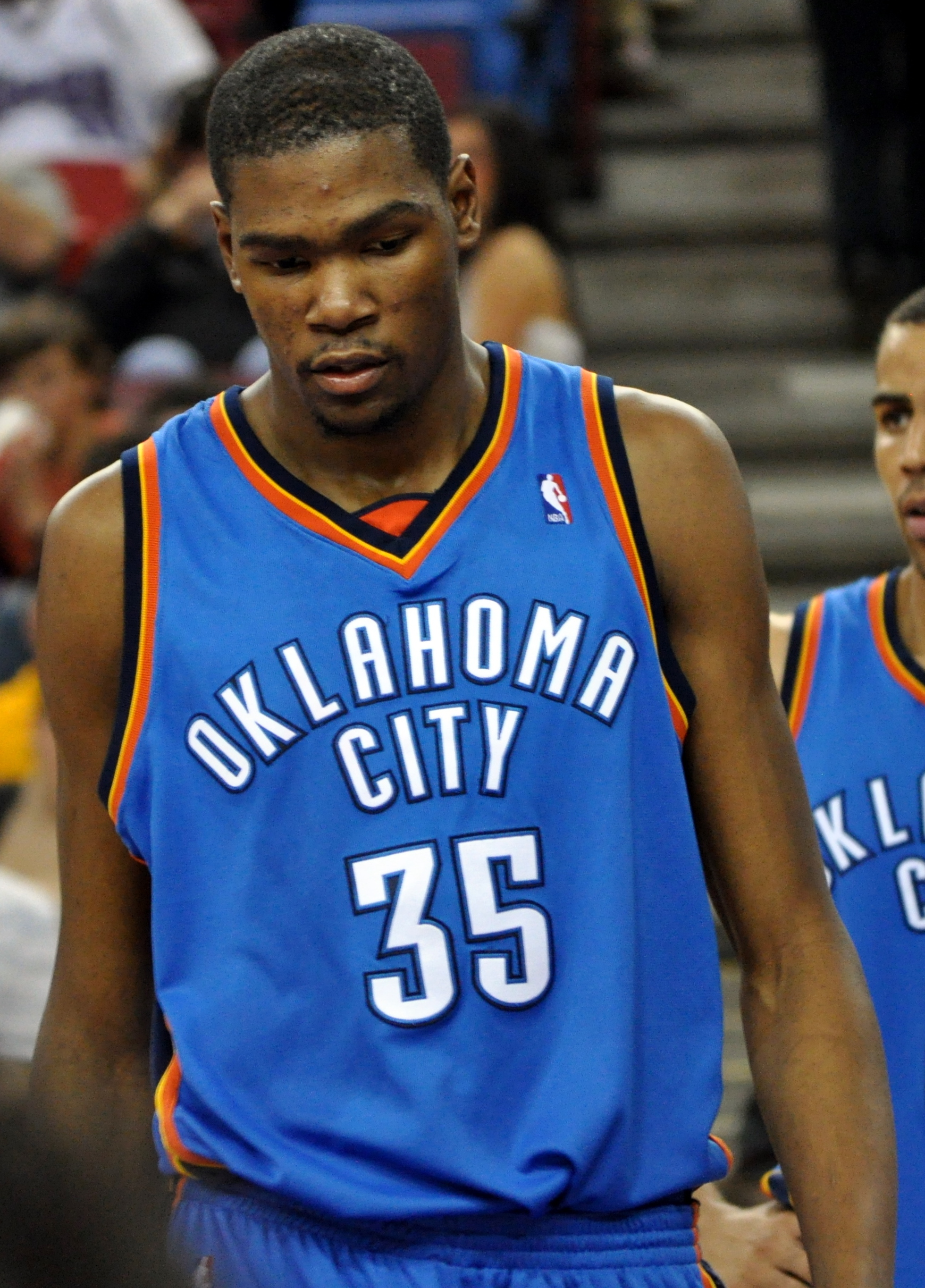
File:Kevin Durant.jpg
Kevin Durant
Kevin Durant is a third year NBA star, currently playing for the Oklahoma City Thunder. Originally from the D.C./Maryland area, Kevin attended college at the University of Texas at Austin. He was selected 2nd overall by the Seattle SuperSonics in the 2007 NBA Draft.
NBA: In his Rookie season, Kevin was named the NBA’s Rookie of the Year and selected as a member of NBA All-Rookie First-Team. That season he also received the NBA Rookie of the Month award five times and averaged 20.3 ppg, 4.3 rpg and 2.4 apg in 34.6 minutes per game. Kevin became just the third teenager to average more than 20 points per game. He scored a career-high 42 points and a career-high 13 rebounds on April 16, 2008 at Golden State at age 19 years 200 days.  No player in the history of the NBA has scored as many points in a game at a younger age.
In his second season, Kevin averaged 25.3 points, 6.5 rebounds, and 2.8 assists per contest for the newly established Oklahoma City Thunder. On February 13, 2009, he captured the MVP award of the Rookie/Sophomore T-Mobile Challenge by scoring a team-high 46 points.
In his third season, Kevin earned his first All-NBA First Team selection after becoming the youngest player (21 years and 197 days) to lead the league in scoring (30.1 ppg). His 756 free throws made was the sixth highest single-season total in NBA history and the highest since Michael Jordan made 833 in the 1986-87 season, while his .900 percentage from the line ranked sixth overall. Kevin also recorded a streak of 25 points or more in 29 straight games, the second longest streak of scoring 25 points or more in league history. He capped his season by leading the Oklahoma City Thunder to the playoffs and earning NBA Western Conference Player of the Month honors for the month of April.
COLLEGE: In his one season at the University of Texas, Kevin completed one of the greatest seasons in the history of College Basketball. In 35 games at UT, Kevin averaged 25.8 ppg (first in Big 12, fourth in the nation), 11 rpg and 1.9 bpg.  He scored 20-plus points 30 times, posted 30-plus points 11 times and recorded 20 double-doubles during his one year as a Longhorn.  Kevin exploded for 37 points and a career-high 23 rebounds at Texas Tech and again posted 37 points along with 10 rebounds, a career-high 6 assists and a career-high six blocks vs. Kansas in the Big 12 Tournament finals.  He was named the Big 12 Tournament Most Valuable Player after scoring a tournament record 92 points.
COLLEGIATE AWARDS: Kevin earned National Player of the Year honors from The Associated Press, NABC, USBWA, CBS/Chevrolet and The Sporting News.  He became the first freshman in NCAA history ever to win the prestigious John R. Wooden Award, the Naismith Award and the Adolph Rupp Trophy.  Kevin earned consensus First Team All-American honors, becoming just the third freshman in NCAA history to earn that honor, joining Wayman Tisdale (1983) and Chris Jackson (1989).  Kevin was named Big 12 Freshman and Player of the Year, earned First Team All-Conference honors and was named to the league’s All-Defensive Team.  On February 25, 2009, the University of Texas retired Kevin’s No. 35 jersey making him just the third player in the 103-year history of the program.
FIBA/USA BASKETBALL: Kevin Durant was a member of the 2010 Men’s USA Basketball team that captured the 2010 FIBA World Championship for the first time in 16 years.
Kevin’s performance in the tournament was nothing short of spectacular. In the last three games of the tournament he scored 33, 38 and 28 points against Russia, Lithuania and Turkey, respectively.
The 38 points in the semi-final game against Lithuania set a new USA Basketball record for most points scored in the FIBA World Championship tournament, while his seven three pointers in the gold medal game against Turkey set a new FIBA World Championship record. Kevin also finished the tournament with U.S. FIBA Worlds record 22.8 points in the event, shattering the 20.2 mark Luther Burden put up in 1974.
His performance earned him a spot on the FIBA World Championship All-Tournament team and the tournament’s most valuable player award

Substitute - Power Forward


Blake Griffin
One of the NBA's brightest upcoming stars, Blake Griffin has quickly become the face of the Los Angeles Clippers franchise. As a prototypical power forward, his dominant physical presence combined with his outstanding size and strength make him one of the NBA's elite athletes. The NBA recognized him as such, by naming him the NBA Rookie of the Month for November.

That award should not really be considered a surprise for the No. 1 draft pick of the 2009 draft — except that he was named the Rookie of the Month for November of 2010, not 2009, the year he was drafted. After dominating summer league play and the 2009 preseason, Griffin suffered a season-ending injury just days before the 2009-10 NBA season was to begin. That is where his strong work ethic and legendary workout sessions quickly made him one of the hardest-working men in the business. It is this constant drive to be the best that has fueled his success and dominance at every level.

Under the tutelage of his father and alongside his brother, Taylor, Griffin led his high school team to four straight Oklahoma state championships, posting an amazing 106-6 overall record during his four-year run. His high school career culminated with his selection as the Oklahoma Player of the Year and a McDonald's All-American his senior season. He arrived at the University of Oklahoma as one of the university's most high-profile recruits in a quarter of a century.

Not to disappoint, Griffin played up to the hype during his freshman campaign as he was named a first-team All-Big 12 selection and to the Big 12 All-Rookie Team after averaging a team-leading 14.7 points and 9.1 rebounds a game and leading the Sooners to a 23–12 record. He was the first true freshman at OU to average that many points and rebounds since Wayman Tisdale in 1983. The rookie recorded 10 double-doubles and scored in double figures in 21 of his last 25 games. He was a two-time Big 12 Player of the Week (Dec. 31 and Jan. 28) and the Jan. 14 Rookie of the Week.

Griffin followed that effort with a sophomore campaign that will likely be remembered as one of the most dominant seasons by a collegiate player. While leading OU to the Sweet 16, Griffin was rewarded for his outstanding play by being chosen the Naismith, Wooden and Associated Press Player of the Year en route to being a consensus selection as National Player of the Year.

In addition, he was named the Big 12 Player of the Year and was a unanimous first-team All-Big 12 selection after averaging 22.7 points and 14.4 rebounds per game. He set a Big 12 record of 30 double-doubles, which was one short of the NCAA record of 31, set by David Robinson in 1986–1987, and he also ranked No. 1 nationally in rebounding and double-doubles (30), second in field goal percentage and 11th in scoring, while his points, rebounds and field goal marks set Big 12 records. His rebound total was the highest in a season by an NCAA Division I player since Indiana State's Larry Bird in 1978-79 and his rebounding average was the highest since Wake Forest's Tim Duncan averaged 14.7 in 1996-97.

He also earned a record-tying six Big 12 Player of the Week awards and recorded at least 20 points and 15 rebounds a Big 12-record 15 times. His season was punctuated on Feb. 14, 2009, when he notched the only game of at least 40 points and 20 rebounds in Big 12 history when he finished with a career-high 40 points and a career-high 23 rebounds against Texas Tech. His 40 points against the Red Raiders were the most by a Sooner in 15 seasons while his 23 rebounds were the most in 20 years.

Having accomplished everything he could at the collegiate level, Griffin declared for the NBA draft in April 2009, citing a lifelong dream of playing in the NBA. On June 25, 2009, a lifetime's worth of hard work was realized as Griffin was selected by the Clippers with the first pick overall in the NBA draft.

And where does he go from here? Well there is no limit to that.

Substitute - Center

dwight howard1 Top Five Centers in the NBA, Going into 2009 2010

Dwight Howard
Howard is considered the "franchise player" of the Magic.[43][44] He is the NBA's leading rebounder (also leading the league in 2007–08 and 2008–09); to illustrate, in a game against the Golden State Warriors on January 10, 2007, his 25 rebounds for the Magic outnumbered the total number of boards grabbed by the starting five of the Warriors.[45] Howard's rebounding is in part facilitated by his extraordinary athleticism; his vertical leap is estimated at almost 40 inches, rare for a player of his size (6'11", 265 pounds).[46] He demonstrated this skill memorably in the 2007 Slam Dunk Contest during the NBA All-Star Weekend, during which he completed an alley oop dunk from teammate Jameer Nelson and slapped a sticker onto the backboard which reached 12 ft 6 in (3.81 m).[47] The sticker showed an image of his own smiling face with a handwritten "All things through Christ Phil: 4:13," a paraphrase of Philippians 4:13.[48] As of April 2010, Howard's career average of 12.7 rebounds per game (in the regular season) ranks 13th in NBA history.[49] The center has also remained largely injury-free in his NBA career, playing in 351 consecutive games before missing his first game.[50]
Howard's abilities and powerful physique have drawn attention from fellow NBA All-Stars. Tim Duncan once remarked in 2007: "[Howard] is so developed... He has so much promise and I am glad that I will be out of the league when he is peaking."[51] Kevin Garnett echoed those sentiments: "[Howard] is a freak of nature, man... I was nowhere near that physically talented. I wasn't that gifted, as far as body and physical presence."[51] Subsequent to a game in the 2009 NBA Playoffs, Philadelphia 76ers swingman Andre Iguodala said: "It's like he can guard two guys at once. He can guard his guy and the guy coming off the pick-and-roll, which is almost impossible to do... If he gets any more athletic or jumps any higher, they're going to have to change the rules."[5] As early as December 2007, ESPN writer David Thorpe declared Howard to be the most dominant center in the NBA.[52]
While many sports pundits have been rating Howard as one of the top young prospects in the NBA since 2006,[46][53][54] Howard has some weaknesses in his game. Offensively, his shooting range remains limited; he is also mistake-prone, having led the NBA in total number of turnovers in the 2006–07 season.[55] Like many centers, he has a low free throw conversion percentage.[6] As a result, he is often a target of the Hack-a-Shaq defense and is annually among the league leaders in free throw attempts. During the 2007–08 regular season, Howard led the NBA with 897 free throw attempts while shooting only 59% from the free throw line.[56] Also in that season, outside of layups and dunks, his shooting percentage was only 31.6%.[21] In the 2008–09 season, he led the NBA again with 849 free throw attempts and in 2009–10, he was second in the NBA with 816.

Point Guard


Jason Kidd
Jason Kidd played basketball all his life. In college Jason Kidd soon to be a basketball great played at California University along with is teammate and soon to be respected opponent, Orlando Magic star Grant Hill. Even with a NBA teammate Jason Kidd had no trouble shinning breaking Kevin Johnson's career steals record of 204 and his assists record of 272. In the 1993-94 Jason Kidd became the first ever sophomore to be named Pac 10 Player of the Year, averaging 16.7 points and 6.9 rebounds, and leading the nation with 9.1 assists per game.
After his great start in college Jason Kidd entered the 1994-95 NBA draft which was a good decision considering he was the No. 2 overall pick. Jason Kidd came into the draft already a real pro winning more awards in high school and college then a lot of basketball athletes put together. He was drafted by the Dallas Mavericks where his NBA rookie year would begin. He showed no hesitation averaging 11.7 points, 7.7 assists, and 5.4 boards a game. Jason Kidd continued putting the numbers up and was named Co-Rookie of the year along with then, Detroit Piston Grant Hill. He was the only rookie to land in the top ten in statistical catagories ranking 10th in assists and 7th in steals. The next year Jason Kidd posted up nine triple doubles ranking him second in the NBA. It was his first NBA All-Star Game getting 1,049,946 votes and becoming the first in Mavs history to start an All-Star Game.
       Kidd only played 22 games with the Mavericks after being traded on December 2, 1997 along with Tony Dumas and Loren Meyer to the Phoenix Suns, for Michael Finley, A.C. Green and Sam Cassell who where traded to the Mavericks. His season didn't start to well with the Phoenix Suns when he recieved a hairline fracture of the right collarbone and a sterno-clavicular joint sprain. He was left sidelined for the next 21 games, helplessly watching. After getting back on the court he once again dominated, kidd had gotten himself and his fiery Phoenix Suns to the 1997 playoffs. Where he started all 5 games.
        Jason Kidd improved more and more while playing with the Suns. He once again reached the playoffs scoring an average of 14.3 points, 7.5 assists, 5.7 rebounds and 4.0 steals.
       The next year Jason Kidd once again stepped up his game leading the NBA in assists averaging 10.8 assists a game. And he lead the Suns in double-doubles, ranking third in the NBA. Not stopping his playoff trend he lead his team to the 1998-99 playoffs. Jason Kidd averaged 15 points, 10 assists, 2.3 rebounds and 1.7 steals against the Portland Trailblazers.
       In the 1999-2000 season Jason Kidd earned himself All-NBA First Team honors and lead the NBA in assists with 10.1 per game for the second season in a row. He was also named All-Defensive second team. As luck would have it though Kidd suffered a broken bone in his left ankle on March 22 after coming to an abrupt stop. He was sidelined through the end of April and missed the Suns first three playoff games. Jason Kidd was a starter in the 2000 NBA All-Star Game in his hometown of San Fransico. So once again he continued his playoff trend but this time went through the first round. Getting back on the court to help his sun clinch the first round 3-1 against the San Antoino Spurs. His Suns went all the way to the Semifinals only to lose to the L.A. Lakers.
       Jason Kidd had a great 2000-01 season season matched his personal best of 16.9 points. He also made history being only the fourth player in NBA history along with (John Stockton, 1988-96; Oscar Robertson, 1964-66; Bob Cousy, 1953-60) to lead the league in assists three seasons straight. He was ranked fourth in the NBA in steals with 2.16 steals a game. With his killer defense Jason Kidd was named All-Defensive First Team for his second season. Making his fourth All-Star appearence Jason Kidd averaged 11 points with five steals, four rebounds and two assists as a starter. Not stopping his playoff trend Jason Kidd averaged 14.3 points, 6.0 rebounds and 13.3 assists in four playoffs games.
       At the end of the 2000-01 NBA season the Phoenix Suns traded Jason Kidd for New Jersey Net Stephon Marbury. The 2001-02 season was a new start for the amazing point guard. Jason Kidd would try for a NBA Championship this time with the New Jersey Nets. The change from the Phoenix Suns was for the good getting his 44th career triple the now New Jersey Nets was controlling the game. Jason Kidd still continuing his playoff trend he blew through the first round against the Pacers winning 3-2. Jason Kidd took the second round winning the Celtics 4-2 and going to the finals where they lost to the L.A Lakers once again.
       In the 2002-03 season the now famous New Jersey Net only has one thing in mind to make it to the NBA finals but this time be the one wearing the ring. That dream was almost accomplished but once again squashed as the Nets lost to the 2003 MVP Tim Duncan and the NBA Champions the San Antonio Spurs. What in store for the future? Will Jason Kidd ever wear the ring?

Shooting Guard


Kobe
Bryant is a shooting guard who is capable of playing the small forward position. He is considered one of the most complete players in the NBA,[158][159] has been selected to every All-NBA Team since 1999, and has been featured in the last twelve NBA All-Star games.[3] Sports writers and sports casters have frequently compared Bryant to Michael Jordan, a comparison Bryant dislikes.[160] In 2007, an ESPN poll of sportswriters voted him as the second best shooting guard in NBA history behind Jordan.[159]
He is a prolific scorer, averaging 25.3 points per game for his career, along with 5.3 rebounds, 4.7 assists, and 1.5 steals (as of the end of the 2009–2010 regular season).[161] He is known for his ability to create shots for himself and is a standout
three-point shooter, sharing the single-game NBA record for three pointers made with twelve.[162] Bryant is often cited as one of the most prolific scorers in the NBA,[163] though his 45.4% career field goal average is considered moderate. He utilizes his wide array of moves and shots to elude defenders and score from virtually anywhere on the floor. Some of Bryant's best moves are his turnaround jump shot, and his ability to post up his defenders and score with a fadeaway jumpshot. Chris Ballard, a Sports Illustrated NBA writer, describes a "jab step-and-pause" as a move Bryant uses where he jabs his non-pivot foot forward to let the defender relax and instead of bringing the jab foot back, he pushes off it and drive around his opponent to get to the basket.[164]
Aside from his scoring ability, he has established himself as a standout defender, having made the All-Defensive first or second team ten of the last eleven seasons.[3] Bryant has also been noted being one of the premier clutch performers in the NBA.[165] For nine consecutive seasons, Bryant has been selected by an NBA GM survey as the player they most want taking the shot with the game on the line.[166] Both
Sporting News and TNT named Bryant the NBA player of the 2000s decade.[167][168]

Small Forward


Kevin Garnett

Already one of the NBA's most talented players for several years, Garnett raised his game to an even higher level in 2003-04 and earned the NBA Most Valuable Player Award. Garnett did it all in his ninth NBA season, leading the Minnesota Timberwolves to their best-ever regular season record (58-24), first division title and first series triumphs in the playoffs (a 4-1 first round victory over Denver and a 4-3 conference semifinal win over Sacramento).
K.G. also set new single-season career-highs in scoring (24.2 ppg, 2nd in the NBA), rebounds (13.9 rpg, 1st in the NBA) and blocked shots (2.17 bpg), in addition to averaging 5.0 assists and 1.46 steals per game.
Garnett's huge year shouldn't come as a surprise. In 2002-03, Garnett posted similar numbers but finished second to San Antonio's Tim Duncan in voting for the 2003 NBA MVP Award. That season, K.G. started all 82 games and posted career-highs in scoring (23.0 ppg), rebounds (13.4 rpg), assists (6.0 apg) and minutes (40.5 mpg).
Indeed, Garnett has come a long way since his rookie season in 1995-96. With his recent dominance on the court, there's no question K.G. has measured up to expectations. In fact, the 6-foot, 11-inch forward has exceeded them.
Garnett's surge to stardom began in 1995 when he was drafted by the Timberwolves directly out of Farragut Academy High School (Chicago) with the fifth overall choice in the 1995 NBA Draft. Although an increasing number of players, including Kevin Garnett in 2003, have made the jump from high school to the NBA, K.G. set the table for them when he became the first player in more than 20 years to be drafted directly out of high school.
His pro career was an immediate success as he was named to the 1995-96 NBA All-Rookie Second Team. He broke the Timberwolves' team record for blocked shots in a season, finishing with 131 rejections in his rookie year.
Garnett's improvement continued into his second NBA season (1996-97) as he participated in his first NBA All-Star Game. That same year he led the Timberwolves to their first-ever appearance in the NBA Playoffs.
By 1997-98, Garnett was getting into his familiar routine of doing everything on the court: scoring, rebounding, passing and defending. It was only a matter of time before he would get his first triple-double and on Jan. 3, 1998, 19,006 fans at the Target Center saw him get it with a 18-point, 13-rebound, 10-assist performance in a 109-87 win vs. Denver.
The next few years were highlighted by similar outings by Garnett but he was doing more than putting strong numbers on the board each night. His fiery style and enthusiasm served as powerful inspiration for his teammates, and with increased maturity, he took on more of a leadership role.
Garnett earned MVP honors at the 2003 NBA All-Star Game in Atlanta with 37 points, nine rebounds, five steals and three assists. Honors after the season included selections to the All-NBA First Team (his fifth overall All-NBA selection), NBA All-Defensive First Team and second-place finishes in voting for NBA Most Valuable Player and NBA Defensive Player of the Year.
Clearly, K.G. has become the driving force behind Minnesota's rise to success. The year before he arrived in the Twin Cities, the team had a 21-61 record. Since then, the team has steadily improved. Although a successful postseason eluded the Timberwolves for years, Garnett & Co. discovered a winning formula in 2004.
Garnett has grown from being the "Da Kid" to now being the "The Big Ticket." He and the Timberwolves have room to grow even more powerful, perhaps into a perennial NBA champion.

Power Forward

Timduncan_display_image

Tim Duncan
Duncan starts at the power forward position, but can also play center. With a double-double career average in points and rebounds, he is considered one of the most consistent players in the NBA.[47] He has earned All-NBA and All-Defensive honors every season since his rookie year in 1998 while being a perennial candidate for the Most Valuable Player and Defensive Player of the Year awards.[3][74] Regarded as one of the league's best interior defenders, Duncan also ranks consistently as one of the top scorers, rebounders and shot-blockers in the league.[3] As of the 2009–10 season, he is ranked third in regular season point-rebound double-doubles.[75] His main weakness remains his free throw shooting, with a career average of less than 70%.[3]
Apart from his impressive statistics, Duncan has gained a reputation as a good clutch player, as evidenced by his three NBA Finals MVP awards and his playoff career averages being higher than his regular-season statistics.[3] Eleven-time NBA champion Bill Russell further compliments Duncan on his passing ability, and rates him as one of the most efficient players of his generation,[76] a view shared by 19-time NBA All-Star Kareem Abdul-Jabbar.[77] Because of his versatility and success, basketball experts have spoken of Duncan as one of the greatest power forwards in NBA history,[47][78][79][80][81] while coach Popovich and team-mates Parker and Ginóbili have also credited much of San Antonio's success to him.[82][83] Duncan's detractors, however, label him as "boring" because of his simple but effective style of play (thus earning him the nickname "The Big Fundamental"). Following his first championship ring in 1999, Sports Illustrated described him as a "quiet, boring MVP",[84] a characterization which persists today.[76]
Duncan himself commented on his "boring" image, stating: "If you show excitement, then you also may show disappointment or frustration. If your opponent picks up on this frustration, you are at a disadvantage."[85] Sports journalist Kevin Kernan commented on his ability to relax and stay focused, stating that having a degree in psychology, Duncan often not only outplays, but outpsychs his opponents.[86] Duncan has also stated that he especially likes his bank shot, saying: "It is just easy for me. It just feels good."[87]